

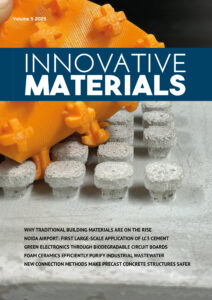
Why traditional building materials are on the rise
In the search for climate-friendly alternatives, the construction industry is turning to familiar materials like wood, soil, and straw. These raw materials absorb carbon during their growth, and when used in buildings, that carbon is sequestered for the long term. Moreover, they produce far fewer emissions during production than con ventional materials like concrete or steel.
Noida Airport: First Large-Scale Application of LC3 Cement
Noida International Airport (NIA) in India is the first major infrastructure project in the country to use limestone calcined clay cement (LC3) on a large scale. In this cement, part of the clinker is replaced by a mixture of calcined clay and finely ground limestone, supplemented with gypsum.
Green electronics through biodegradable circuit boards
Modern printed circuit boards are typically made of petroleum-based resins and are difficult to recycle. Researchers at Empa have now developed a fully biodegradable alternative, a significant step toward more sustainable electronics. The new material is based entirely on wood and can be used for functional printed circuit boards in electronic devices.
Foam ceramics efficiently purify industrial wastewater
Industrial processes and wastewater pose a significant environmental challenge. Researchers at Fraunhofer in Dresden have now developed compact, energy-efficient systems that effectively break down impurities using photocatalytic oxidation. At the heart of this technology is foam ceramics with multifunctional coatings.
New connection methods make precast concrete structures safer
Connections are often the weak points in precast structures. The new designs should make precast concrete buildings more resistant to sudden damage, for example, from earthquakes, floods, or explosions.


