

2,000-Year-Old Workshop in Pompeii Reveals Secret of Roman Superconcrete
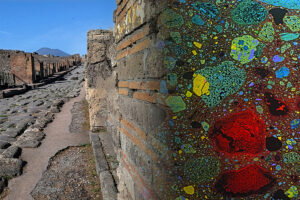
An ancient wall in Pompeii at a recently excavated site, where MIT researchers unraveled how ancient Romans made concrete that has lasted for thousands of years (Credits: Pompeii Archaeological Park)
December 9, 2025 – Using a recently discovered and exceptionally well-preserved construction site in Pompeii, scientists have discovered how the Romans made their durable superconcrete. The quality of this concrete has ensured that many Roman monuments and buildings still stand thousands of years after their construction.
MIT researchers examined piles of raw materials, tools and an unfinished wall that remained untouched after the eruption in 79 CE.
Their study shows that Roman builders did not work with a wet lime paste, as traditionally assumed, but with a dry blend of lime and volcanic ash. Water was added only during construction. This triggered a strong heat reaction that left small lime fragments active within the concrete. When cracks formed over time, those particles dissolved and recrystallized, sealing the gaps. This process helped the material remain robust for centuries.
The findings indicate that Roman construction methods were more practical and technically refined than written sources imply. The approach may inspire modern building materials with greater durability and lower maintenance demands.


