

Aerosol jet printing enables precise electronic components
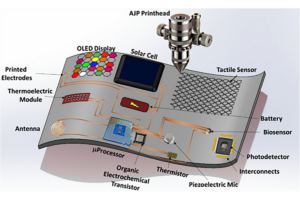
September 29, 2026 – Scientists at Los Alamos National Laboratory have developed a new method for 3D-printing tiny glass components into any desired shape. They achieve this using aerosol jet printing – a technique well-suited for creating complex lenses, optical systems, and extremely small glass components. Traditional glass manufacturing methods fall short for such applications, but this new technique solves that problem.
Aerosol jet printing allows researchers to deposit extremely fine patterns of different materials onto surfaces. The technique uses a mist of tiny ink droplets directed towards a substrate.
Unlike many conventional manufacturing methods, the print head does not need to touch the surface. This makes it possible to print onto curved and three-dimensional components.
The technology is particularly promising for electronic circuits, sensors and other miniature devices. Various inks can be used, including electrically conductive materials.
One advantage is that patterns can be deposited directly, often without complex masks or specialised cleanroom facilities.
This summer, a state-of-the-art article on aerosol jet printing was published in the journal Advanced Materials Technologies, titled ‘The Evolution of Aerosol Jet Printing, A Review: Enhancing Material Versatility and Improvements for Next-Generation Applications.’


