

Scientists unravel the secret of 1,600-year-old Roman glass
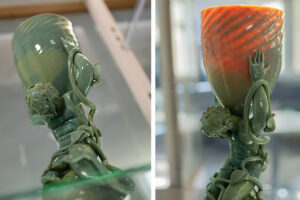
(Photo: Scheffield University)
October 26, 2026 – Researchers at the University of Sheffield have successfully reproduced a remarkable type of Roman glass that changes colour depending on how light passes through it. Their achievement helps solve a centuries-old mystery surrounding the famous Lycurgus Cup.
Dating from the fourth century, the Lycurgus Cup is housed in the British Museum in London. Its glass appears jade green in reflected light but turns ruby red when light shines through it. This phenomenon is known as dichroism.
The unusual colours are believed to result from extremely small particles of gold and silver embedded in the glass. These nanoparticles affect how light is absorbed and transmitted.
Glass specialist Lisa Hollands worked with Professor Caroline Jackson to investigate the composition of Roman glass. Hollands then experimented with different raw materials, furnace types and oxygen levels.
After numerous trials, she developed a repeatable recipe that successfully reproduced the distinctive colour-changing effect.
Glass artist Elliot Walker subsequently used the material to produce a contemporary sculpture inspired by the original Roman cup.
The artwork will be exhibited at Sheffield’s Festival of the Mind in November 2026 before moving permanently to the Turner Museum of Glass.
Beyond revealing insights into ancient Roman glassmaking, the research could support the development of advanced optical materials and specialised glasses for the safe storage of radioactive waste.


