

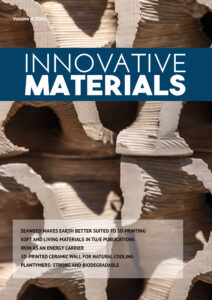
Seaweed makes earth better suited to 3D printing
An ingredient used, among other things, to give ice cream its creamy texture could help make earth suitable for 3D printing. Researchers led by the University of Colora do Boulder discovered that adding a small amount of sodium alginate makes mixtures of clay and sand easier to print. The technique could contribute to the reuse of excavated soil as a construction material.
Soft and living materials in TU/e publications
Three recent TU/e studies offer new insights into soft and living materials. They ad dress processes in polymers, new materials for light technology, and forces exerted by living cells. Despite the diverse topics, the focus is on a single goal: gaining a bet ter understanding of materials and leveraging this knowledge for new applications in technology and healthcare
Iron as an energy carrier
Iron powder could potentially play a role in the long-term storage and transport of large quantities of renewable energy. Researchers at the Karlsruhe Institute of Technology investigated its application within a climate-neutral European energy system. According to their analysis, iron will not replace hydrogen but could serve as a valuable complement.
3D-printed ceramic wall provides natural cooling
Researchers at TU Graz have developed a 3D-printed ceramic wall capable of cooling buildings and urban spaces without active cooling. The porous elements absorb water and provide cooling through evaporation. In a field test, a temperature drop of nearly 7°C was measured near a water-filled element.
New plant-based plastic is strong and biodegradable
Researchers from Wageningen, Amsterdam, and China have developed ‘planty meer’: a strong, relatively water-resistant, and biodegradable plastic based on corn proteins. The production method is inspired by the way spiders create strong silk threads. The new plant-based material could offer a more sustainable alternative to conventional plastics.


