

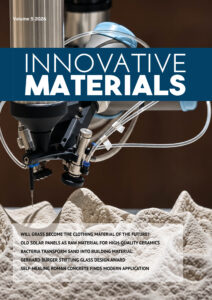
Will grass become the clothing material of the future?
In the future, grass and clover could serve as a raw material for clothing. Swedish scientists have demonstrated that usable cellulose can be extracted from the rem nants of these crops to produce textile fibers. A first piece of fabric has already been knitted from this material. This reduces reliance on wood and makes better use of agricultural waste streams.
Discarded solar panels as raw material for high-quality ceramics
Old solar panels can be recycled into high-quality ceramic material. South Korean researchers have succeeded in purifying the silicon from discarded panels to a level of 99.95 percent. This purified material was then converted into silicon nitride, which can be used in automobiles, machinery, and medical equipment. This provides a valuable new purpose for the growing stream of electronic waste
Bacteria turn sand into building material
Researchers at ETH Zurich are creating sturdy building materials with the help of bacteria. By combining biological processes with 3D printing and robotics, they can bind sand grains together to form structural elements. This innovative technique eliminates the need for traditional, energy-intensive cement production, allowing building components to be manufactured without the extremely high temperatures typically required.
Gerhard Bürger Stiftung Glass Design Award
Six young designers were honored during the fourth international Glass Design Award. The competition, themed ‘Glass can…’, was organized by the German Ger hard Bürger Stiftung. The winning projects ranged from natural sculptures to innova tive lighting and works made from recycled glass. They demonstrated the immense versatility of the material by successfully combining traditional craftsmanship with contemporary design techniques.
Self-healing Roman concrete finds modern application
The American start-up DmAat is developing self-healing concrete based on centu ries-old Roman construction techniques. Roman concrete structures are still standing after two thousand years, which prompted research into their durability. By applying this knowledge to modern concrete, small cracks can be repaired automatically. This significantly extends the lifespan of modern structures and also helps to reduce global CO2 emissions.


