

When liquids get stuck
(Image | PhD thesis Corentin Laudicina)
17 September 2026 – Why does a liquid sometimes become increasingly viscous when cooled, without crystallising in the usual way? Researchers at Eindhoven University of Technology are studying this phenomenon, known as the glass transition.
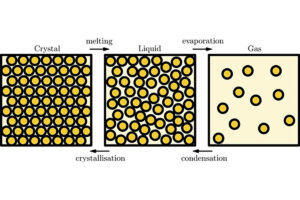
During an ordinary phase transition, such as water freezing, molecules form an ordered crystal structure. Glass formation works differently. Particle movement slows dramatically while the arrangement of the particles remains largely disordered. As a result, the material increasingly behaves like a solid.
An important research question concerns how particles move collectively. In a deeply supercooled liquid, some regions can still rearrange relatively easily, while others are almost motionless. These differences in mobility help explain why the material’s overall movement slows so dramatically.
Understanding this process is important for polymers, glassy materials and industrial manufacturing. Better knowledge of the glass transition could help scientists understand and predict properties such as deformability, stability and ageing in materials that lack a regular crystal structure.
Depending on the phase, molecules in a material move in very different ways.


